Airline Refund Policy Explained: Service Transparency Across Regions
Airline Refund Policy Explained: How Operational Differences Shape Passenger Outcomes

Airline refund policies often appear inconsistent, even when travelers experience similar disruptions. A cancelled flight in one region may result in a prompt refund, while a comparable event elsewhere leads to delays, credits, or layered procedures. These differences are not random. They reflect how airline operations interact with regulatory expectations, consumer protection rules, and internal service structures.
Across the United States, the United Kingdom, Europe, and selected Middle Eastern and Nordic jurisdictions, refund handling is shaped by operational design. Carriers operate under different disclosure standards, payment infrastructures, and compliance timelines. Understanding these operational differences is essential for interpreting refund outcomes without assuming uniform treatment.
This article explains airline refund policy from a service transparency perspective. It provides educational context on how refund processes work, why they differ, and how regulatory and operational factors influence what passengers experience during disruption events.
Concept Clarification: What an Airline Refund Policy Covers
An airline refund policy outlines how payments are returned when transportation is not provided as agreed. Refunds are tied to service non-performance rather than inconvenience, making them distinct from compensation or goodwill gestures.
From a regulatory standpoint, refunds address the core transaction: payment exchanged for transportation. When a flight is cancelled and not delivered, refund obligations may arise regardless of cause. Compensation, by contrast, often depends on additional criteria such as notice period or operational control.
Operationally, refund policies sit at the intersection of ticketing systems, payment processors, and compliance rules. The policy itself is only one element; execution depends on how systems are configured and how service teams interpret regulatory requirements.
Decision Factors Behind Refund Policy Outcomes
Regulatory Baselines and Disclosure Requirements
Refund policies operate within regulatory baselines that differ by region. Some jurisdictions mandate refunds within defined timeframes and require clear disclosure of refund rights at the point of disruption. Others focus more heavily on ensuring that advertised policies are honored consistently.
These baselines influence how transparent refund communication must be and how quickly funds are returned. A structural overview of how refund obligations fit within broader passenger protection frameworks is available in [Internal link to pillar article].
Operational Processing and Payment Infrastructure
Refund timelines are affected by operational design. Payment method, ticket type, and intermediary involvement can all influence processing speed. Refunds issued through travel agencies or corporate booking platforms may pass through additional layers before reaching the passenger.
While these delays are often operational rather than regulatory, transparency expectations increasingly require airlines to explain the process clearly rather than relying on generic timelines.
An analytical perspective on how operational constraints affect refund outcomes is explored in [airline cancellation refund rights].
Voluntary Versus Involuntary Changes
Refund policies also distinguish between voluntary changes initiated by the passenger and involuntary changes caused by the airline. Involuntary cancellations generally trigger stronger refund obligations, while voluntary changes are governed more strictly by fare conditions and contractual terms.
Clear classification is essential for service transparency. Misunderstanding whether a change is considered voluntary can lead to confusion about refund eligibility.
Scenario-Based Illustrations of Refund Handling
Airline-Initiated Cancellations
When a carrier cancels a flight, refund obligations are usually straightforward from a regulatory perspective. However, operational execution may vary. Some systems process refunds automatically, while others require manual validation or passenger confirmation.
These differences stem from internal service design rather than passenger entitlement, underscoring why outcomes can feel inconsistent.
System-Wide Disruptions
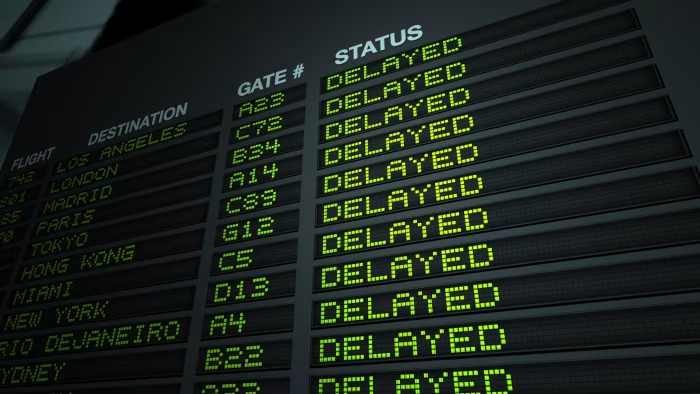
During large-scale disruptions, refund processing volumes increase sharply. Airlines may implement temporary measures to manage demand, such as extended processing windows or centralized refund queues. Regulatory expectations around transparency remain in place even when operational strain is high.
For broader educational context on how disruption information is communicated during such events, see [airline refund policy explained].
Managed and Corporate Travel Contexts
In corporate travel environments, refunds may be routed through employers, travel management companies, or expense platforms. While this can extend processing time, regulatory responsibility typically remains with the airline.
Service transparency depends on clear communication about where the refund is in the process rather than on immediate resolution.
Practical Insights for Interpreting Refund Policies
Transparency Over Speed
Refund policy effectiveness is often judged by clarity rather than speed alone. Regulators increasingly focus on whether passengers are informed about timelines, methods, and reasons for delay, recognizing that uncertainty amplifies dissatisfaction.
Refunds Within a Broader Protection Ecosystem
Refunds interact with travel insurance, payment protections, and corporate expense controls. Insurance claims may consider refunded amounts, while payment providers reference refund rights when resolving disputes. These interactions position refunds as a foundational element of travel service transparency.
Documentation and Communication Standards
Accurate records and consistent messaging support transparency. Regulators assess whether refund explanations are complete and accessible, particularly during disruption events when information gaps are most likely to occur.
Neutral Summary Closing
Airline refund policies reflect how operational design, regulatory baselines, and service transparency intersect within modern travel systems. Differences in outcome often arise from how refunds are processed and communicated rather than from the existence of refund rights themselves.
By viewing refund policies through an educational lens, passengers and organizations can better understand why experiences vary across regions and situations. Within this context, refunds function as a core transparency mechanism—anchored in regulation, shaped by operations, and sustained through clear communication—rather than as a discretionary service outcome.